The influences that shape the album are not very bountiful when they are projected in the same manner, but by adding swift turns, sharp maneuvers and by having savvy flexibility, the riffs here are sprayed furiously upon the listener, spiking suddenly and then drawing back, simply introducing standard influences in a most spiking way. The riffs are totally flashy and sudden, and before you can have a moment's respite after a gnawing incursion of bestial black/thrash, another onset is at your door, and it strikes before you can have a moment to breathe. The really great factor about the Ep is that fact that these guys have definitely worked hard while writing the riffs and arranging the songs in structure. Many might hear basic tremolo passages and typical diminished black metal chord strums, but deep within the turbulent assault of riffs, you'll notice there are technical details added, and Holodomor actually present this in the most accessible way possible. A great trait.
Monday, April 9, 2018
Holodomoor - Temoignages de la Gnose Terrestre
HOLODOMOR debut MCD Temoignages de la Gnose Terrestre presents five devastating pieces of sonic cruelty executed with an immense brutality. Conceptually soaring beyond the cliches of ideological fallacies of the genre, the spirit of HOLODOMOR conveys genuine visions of inhumanity, violence and self-abjection.
Chainsaw - The Announcement
Cult Chilean black metal solo project! You may remember their 2001 demo we had in the past "Satan I Obey!", until 2007 this was the only CHAINSAW release available! The Announcement was composed between 1997 and 2001 and is the final opus from CHAINSAW.
Dedicated to all true Satanists, Occultists, Devotees of Evil Metal!
Pro tape, gold print.
Dedicated to all true Satanists, Occultists, Devotees of Evil Metal!
Pro tape, gold print.
Sunday, April 8, 2018
Cavalera Conspiracy - Psychosis
Is it 1991 again? Because Cavalera Conspiracy’s new album Psychosis feels like something that’s as fierce as something we’d get from these Brazilian brothers in the early 1990s. It seems to revisit some of the biggest and loudest points in the careers of both brothers with the overall sound of this album feeling like an aggressive and warlike revisit of Chaos A.D. and Arise throughout with bits of Max’s old side project Nailbomb thrown into the latter half. Psychosis mixes all of this together into a bright-burning molotov cocktail of extreme metal that feels as though Max and Igor have been rejuvenated and acquired a lust for speed and bloodshed. Psychosis has the thrashing energy for real terror.
Don’t expect a bunch of chugs on here. This album instead runs on speed and barrages of savage guitars. Even the groovier songs sound angrier, more ferocious, and downright hellish compared to what we normally expect from a modern Cavalera album. Rapid-fire drums and menacing riffs break you into the album and give you a hint as to the torrent of terror you’ve just entered. The first half of Psychosis is a ferocious volley of menacing thrash as the opening number “Insane” demonstrates quite clearly with its raw speed and rage. It can also handle groovier sounds while maintaining the menace, with “Spectral War” mixing groove riffs and thrash pacing to create a song that feels like being trampled under thousands of charging hooves. Max’s vocals are still as vicious as ever and make the atmosphere all the more chaotic. On terms of the musical backbone of Psychosis, It’s strong as rebar and covered in spikes.
Psychosis sounds positively evil and does some calling back to the sounds of Sepultura’s glory days. It doesn’t totally match up to how iconic Arise or Chaos A.D. were. However, you can tell that Cavalera Conspiracy is trying to hit new heights rather than simply pumping another album out to stay alive. “Spectral War” is energetic, evil, and memorable, as are other songs on this album. They sound like songs that were written to be remembered and replayed like the band had channeled all of their fury into this. This album also stretches the boundaries a bit by using Nailbomb-esque industrial elements on some later tracks. These tracks aren’t especially mind-blowing, but the industrial elements mesh well with the music at large, and overall are still decent, just not as blisteringly savage as the earlier songs. It at least shows a willingness to still experiment even after all these years, and to make their experimentation go smoothly with their core sound. That is something that I find commendable from a band like this that tends to get brushed aside as a side attraction to Soulfly and Sepultura. They resurrect the old strong sound and infuse it with some new power.
Psychosis feels like an album that took the best parts of the Cavalera brothers’ careers and decided to not only pay tribute to them, but revive them in such a way that they feel reinvigorated and just as crunchy as ever. This may not hold a candle to classic Sepultura albums, but it tries the hardest it can to get up to that level and delivers some pretty ripping songs in the process. Psychosis pounds, shreds and smashes while staying as menacing and vicious as one hundred clones of the warrior on the front cover. Whether it’s the manic thrashing songs, the imposing march-like groovier pieces, or even the noisy industrial bits, you always feel like you’re under siege from Cavalera Conspiracy’s assault. This album hit me way harder than I expected. It may not be a game-changing masterpiece, but Psychosis shows us that the bros from Brazil can still deliver super savage metal even after all these years and all the stylistic shifts. Granted, the outro narration on the last minute of the last track is cheesy, but after listening to the other forty minutes of this blast from the past, I think they can get a pass on that.
Monday, May 30, 2016
Horna - Askel Lähempänä Saatanaa (2013)
There are albums that one has to check out. It’s not that they’re necessarily relevant for many, but for some reason, one wouldn’t be able to sleep calm knowing that has skipped something that makes you curious. That happens to me at least, and that’s the reason why I’m writing this now.
Horna are a black metal Finnish act, and if not considered one of the classic bands of the Scandinavian wave of bands playing such genre back in the early 90’s, they are right in the outskirts of that category. Me, I’ve listened to some of their work along the years —they’ve released about 30 demos, splits and shit— so I can say that I’m familiar with what they do. The problem lies right there actually, if there’s a problem at all.
I certainly had the time of my life listening to the truly evil sound in “Askel Lähempänä Saatanaa” —whatever that means, Google translator is for fags— and I enjoyed it exactly for the same goddamn reasons that I’ve enjoyed every single work by these guys that I’ve had the chance to check out: cold riffs and melodies, raw distortion, wicked drumming and truly malevolent vocals all creating that cold raw and disturbing atmosphere that I’m so addicted to.
I know, I know: You’ve read the above description a million times before, always about black metal bands that stick to that old Norwegian sound, uh? You’re so right! So, what’s the point of listening to this? Well, not because it has become a cliché I have become myself unable to enjoy it, you know. Yes, there’s a bunch of albums that one could listen to having pretty much the same effect, and yes, it’s also possible that there are better releases of this kind —although, that’s always arguable—. And still, how many bands have been around playing and perfecting such sound for nearly two decades now? In my book, twenty years do validate a lot of what a band does.
Now, how perfect can this kind of metal be? Much of its beauty lies precisely on its ugliness. Horna’s latest is raw, noisy and disturbing, and it definitely feels anachronistic. This is not an attempt to revolutionize black metal in any way, au contraire, it is all about Horna doing their thing. And I do like it. At the same time, you can put a check mark in every must for a release of this type, and no, that doesn’t necessarily means that they are emulating them. This is not one of those records…
Proof of how well this album is made is the fact that playing a most primitive kind of black metal, Horna managed to make 48 minutes pass so fast, that the end actually got me by surprise. Also, there IS real coherence amongst themes, riffs, solos and leif motifs, and for once —and without spoiling the experience with clean production— you can actually listen to the bass lines. That always helps for the feeling of atmosphere to be complete.
Not trying to innovate anything, and still, Horna do their thing and they do it right. In a way that’s refreshing in a world where pointless sophistication has fucked up almost every sub-genre in metal. Not that it is going to become a classic, but I would recommend this to any black metal fan. I’m sure they’ll understand.
The Kovenant - In Times Before the Light
This is awesome, they brought back their black metal roots with industrial touches. This release is something really special. It takes me back to when I heard this album originally. It was great, but this "remix" album is lot better. It takes this album to next level and creates something new and unique. I know that many bands use industrial and black metal together, but Kovenant did this better.
The album starts with this dark atmospheric industrial loop and seconds later gives a blasting start. It reminds me of Dimmu Borgir's Puritanical Euphoric Misanthropia and is filled with electronic and symphonic elements like this remix album. The only minus here is that it can be little bit noisy, maybe because of the mixing and sometimes it's very hard to focus on listening to just one instrument, but for the record I understand it is hard to add electronic synths to album recorded first with only black metal + symphonic synths.
In times before the light remix album, it works well and makes first version sound like something is missing. It does miss these electronic effects and keyboards and this theme unites it with other Kovenant albums. I would personally love to hear this album re-recorded.
My favorite song here is definitely "In Times Before the Light". It's complex, all the way awesome, and has a warm synthesizer theme and melodic orchestra. The vocals are evil and haunt your ears all night.
I recommend this to every industrial black metal fan. For all the people who enjoy electronic touch.
Buy
Listen
Saturday, May 21, 2016
Darkness - Defenders of Justice + Demos, 1988 (Ger)
Ok thrash metal friends, do you know or remember Darkness from Germany? No??? Bad thing! This group is one of the most overlooked things in thrash that, back in the 80s, released two great albums. “Defenders Of Justice” is one of these two. We are so blinded by groups like Kreator, Sodom, Destruction and many others, that we forgot about this one that surely deserves more attention and respect.
I found this LP in a second hand shop and I immediately bought it. This group is pure energy. These tracks are pure thrash metal in German way. The up tempo and the excellent refrain on “Bloodbath” are a piece of underground history. The production is in pure 80s style but very good and heavy; the guitar sound is always solid, followed by truly characteristical vocals. They are similar to scratches on the wall. Great. “Inverted Minds” is well balanced with an almost speed metal refrain.
Diabolical Messiah/Swarm of Terror - Embrace the Advance of Victory (Chl)
Alliance between two southamerican nowadays well known black death metal hordes ! Bestial and immense attach on the christian rites with intense blasphemy ! Satanic Death Metal in the Southamerican way. Recommended !!!
Tracklist
1. Diabolical Messiah - Internal Defiant Discipline 02:19
2. Diabolical Messiah - Chaos in the Supreme Battle 02:48
3. Diabolical Messiah - Evoking the Diabolical Attack 02:55
4. Swarm of Terror - Embrace the Blasphemous Rebellion 06:31
5. Swarm of Terror - Transformation of Wrath Into Obscurity 04:04
6. Swarm of Terror - The Greatest of the Horns and the Unholy Victory 06:56
Total 25:33
Ebola - Hell's Death Metal (Pol)
Horde is back after four years of silence. Half an hour fucking death metal in the stale old-school atmosphere moves you into the abyss of the early nineties. Eleven hellish, profane, hateful tracks crush the naive and blind into dust with their massive sound. Additionally in the end of album industrial track by Horologium. Album released in a standard box. All copies hand numbered. CD with graphics pressing. This album proves Ebola its lead in the home throne of old school death.
Delirium - Zzooouhh + Live/Demos, 1990 (Hol)
A very especial repress of one of the OOP and most sought-after Memento Mori reissues: none other than DELIRIUM´s "Zzooouhh". Aptly titled "Zzooouhh + Demos/Live", this 2CD set features the "Zzooouhh" album (1990), the "Delirium" demo (1988), the "Amputation" demo (1989) and a full live show recorded straight from the soundboard @ Network (Aalst, Belgium) back in March 31st, 1991. Over 130 minutes of rancid, primitive and odorous Death/Doom Metal like some sort of Celtic Frost / Dream Death meets early Asphyx, Obituary, early Death and Necro Schizma, with one of the most putrid voices ever. All songs were subtly remastered by Ted Tringo at The Ancient Way Mastering (U.S.A.). Expanded / upgraded layout by Ted Tringo as well, including liner notes by Mark Honout (Delirium´s guitar/vox), Ricard García (Morbid Visions ´zine), Wannes Gubbels (Pentacle, Asphyx), Costa Stoios (Tales Of The Macabre Mag, Iron Pegasus Records), Stephan Gebédi (Hail Of Bullets, Thanatos) and Olivier "Zoltar" Badin (Terrorizer Mag), as well as rare old pics and flyers.
Palace of Worms – The Ladder
Though black metal has certainly progressed over the past decade, there are moments in which I ask myself, “Okay, so what’s next?” Sure, bands are taking the sounds pioneered by their predecessors and “expanding” upon them, maybe adding elements of post-rock (which is so overdone now – hey fledgeling post-rock black metal bands, do something else) or a minute extra-genre influence to make at least a minor mark, but there really hasn’t been much which has made me tilt my head and remark on its originality. Hell, we’ve been stuck in the post-Romantic era for the better part of two hundred years. How can we go forward?
In its seven tracks, USBM hermit Balan’s Palace of Worms takes what we might consider black metal, strip it to its bare elements, turn it on its head, and act as a master carpenter. Upon its inverted base, which, as evidenced by riffing style and harsh vocal approach, is clearly black metal, Balan ascends this eponymous ladder rung by rung, rising from genre distinction. Within The Ladder, Balan touches on gothic music and post-punk – “Wreathe” features a very apt Lycia impression, down to Mike VanPortFleet’s melodramatic enunciation – post-hardcore, shoegaze, and the ephemeral avant-garde, all while maintaining a significant “self.”
Throughout its many experiments, where Palace of Worms shines brightest is in its self-synchronicity – too many bands adventure from the norm and return altered and synthetic, yet Balan’s many-tentacled approach retains a central sound focus. This is how a genre successfully progresses, maintaining a constant backwards gaze while reaching and clutching onto whatever might tastefully fuse. I hate to use the word “alchemy,” a word I see far too often in press releases, but Balan definitely turns potentially haphazard experiments into gold. This is the first real step in “what comes next” that black metal has made in a long, long time.
The Ladder will be unleashed on April 8 via Broken Limbs Recordings, Sentient Ruin Laboratories, and Acephale Winter on LP, cassette, and digital formats. Read a statement from the artist below and listen to an exclusive full-album stream of The Ladder below. Support your favorite artists and labels.
Austerymn - Sepulcrum Veventium (UK)
Previously known as Perpetual Infestation (1990-1991) and Godless Truth (1991-1996), these seasoned U.K. scenesters came back from the deceased in 2007 and re-christened their decayed corpse as Austerymn, only to perpetuate and pay homage to the repulsive odour of the ancient Metal of Death that runs through their utterly infected veins, most especially that from Sweden´s heydays. Unashamed proud to play a style they grew up with and love, Austerymn will definitely appeal to all fans of the crunchy and crushing -yet melodic in a not cheesy way- tone of bands like Entombed, Dismember, early At The Gates, Carnage, Grave, early Desultory, Nirvana 2002, God Macabre, early Evocation and Wombbath. Authentic old school Death Metal of the finest and classiest kind!!! "Sepulcrum Viventium", the band´s debut full-length, was recorded and produced by Fotis Benardo in Greece and Rik Simpson at The Fly Studio in Stoke On Trent (England), and features guest guitar solos by George Emmanuel (Rotting Christ, Lucifer´s Child) and Carlo Regadas (Monstrance, ex-Carcass, ex-Blackstar, ex- Devoid). Cover art by Wolven Claws Artist. Layout and design by Ola Sjöberg (God Macabre). Band´s logo by Christophe Szpajdel.
Sodom - Satans Conjuration + Live in Essen, 1984 (Ger)
There is a second version of this bootleg that has the same material but a different layout. I don't own it yet so I can't do a full comparison. The original '99(?) version has yellow text on the backside of the booklet (a dedication to some obscure metal bands and a note about the recording source). The new version has an old photo of Sodom on the back of the booklet.
Packaging includes some nice vintage pictures and the text of an old article/interview. The way the liner notes are written at times sort of insinuates the band approved of this CD or that it's semi-official, which is not true. The bootleg itself readily admits the material comes from 2nd or 3rd generation tapes, but other than tape hiss, the demo and live stuff is of pretty good quality considering the age.
On the back insert, the first 9 tracks are under the heading Witchhammer. Some people have inferred that Sodom actually had a full demo called "Witchhammer" or "Satan's Conjuration;" anyone using these names for these tracks is a clueless fool. Likewise, anyone who thinks the Venom cover is from the demo sessions is a moron.
On the original demo, "Let's Fight In The Darkness Of Hell" was listed as "Lets Fight" [sic]. "Live From Hell" was also listed as "Life From Hell." And actually, it does sound like Tom is singing the word "life." But it is possible this was the result of bad English or a misspelling on the demo tape (keep in mind the original demo tracklisting misspelled the sixth track as "Poisend Blood" and had no apostrophes in any of the titles).
"Satans Conjuration" is an early version of "Conjuration."
Track 9 is from the In the Name of Satan Venom tribute album. Abaddon himself plays drums on this track and Mille plays guitar. It's from the early-mid '90s but I'm not sure of the exact recording year.
The live tracks are from a show with Destruction. "Burst Command 'Til War" is particularly sloppy and dissonant--rather endearing, actually.
Morbid Angel - Altars of Madness
When Morbid Angel released "Altars of Madness" in 1989, it immediately assumed its place as death metal's first legitimate masterpiece. Building on the basic ideas of Slayer, Morbid Angel combined a stripped down, punk influenced rawness of performance with unconventional song structures and longer melodic phrases. In doing so, they created a style all their own, driven by churning, chaotic guitar riffing and solos that scream with reckless abandon. The interplay between Azagtoth and Brunelle's guitar styles makes the album - Azagthoth plays go-for-broke atonal solos, while Brunelle is more traditional and restrained (a relative term of course). They complement each other perfectly, Azagthoth embodying the savage spirit of hellish death metal, while Brunelle's cleaner and more musically literate playing provides balance and distinction to the songs.
Spiritual Beggars - Ad Astra
Led by former CARCASS / current ARCH ENEMY six-stringer Mike Amott, Sweden's SPIRITUAL BEGGARS have been making critically-acclaimed, SABBATH-inspired "stoner rock" albums for about half a decade so far, and their songwriting skills are rapidly improving with each successive release, as clearly evidenced by their third—and finest—full-length CD to date. Much to the band's credit, SPIRITUAL BEGGARS have not altered their style or attempted to deviate from the tried-and-tested formula in order to attain greater commercial success. Instead, they have focused all their efforts on tightening up their songwriting and perfecting their execution, which is virtually flawless, as the band deliver 12 songs of crushingly heavy, riff-laden metal that is as catchy as it is powerful.
As before, SPIRITUAL BEGGARS appear to be unconcerned with the prospect of breaking new musical ground, and there is admittedly very little on Ad Astra that has not been done before in one form or another by countless other similar sounding acts. However, where this trio clearly excel is the quality of their songwriting, and you'd be hard-pressed to find another band in this genre of music delivering material as strong as "Angel of Betrayal" or opener "Left Brain Ambassadors".
Featuring excellent production courtesy of Fredrik Nordstrom, Ad Astra is a must-have for fans of old SABBATH fans as well as for anyone with an appreciation for thick, guitar-heavy music done with a decidedly retro feel.
One Minute Silence – Buy Now...Saved Later
Arguably the UK's best hope of contributing a worthy homegrown act to the current hip hop/metal explosion, ONE MINUTE SILENCE have already done a fair bit of touring Stateside, where they've only had limited commercial success thus far. Dubbed by some a "more aggressive RAGE AGAINST THE MACHINE", OMS' sophomore effort basically picks up where the debut (1998's Available In All Colors) left off, with a thicker production and a stronger batch of tunes than the last time around. To the group's credit, there is no evidence that they've adopted any of the KORN-isms or BIZKIT-isms that are running so rampant in the US rock scene, but have instead been working on solidifying their sound, with RATM still standing as the most obvious reference point (due in no small part to vocalist Barry's Zack de la Rocha-like delivery). Unfortunately, there just still aren't a whole lot of very memorable hooks on here, and the band's angst-driven approach gets tiresome rather quickly, ultimately making for a less than exciting listening experience.
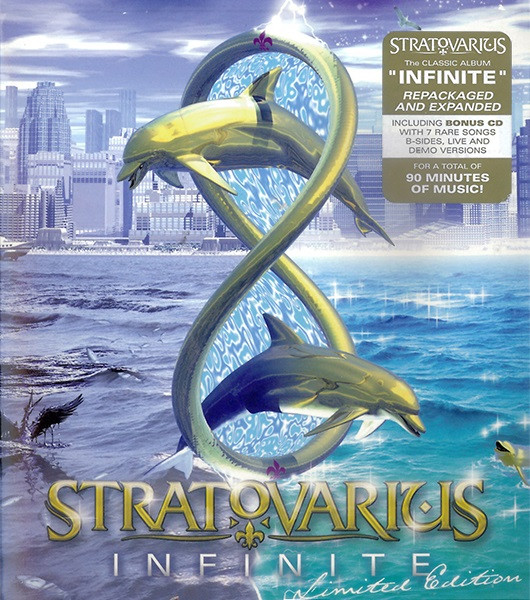
Stratovarius - Infinite
Having been a fan of STRATOVARIUS' neo-classical sound since the group's excellent 1996 Episode release (the band's fifth), I was genuinely hoping that the quintet's latest album would offer a slightly different twist to what has become an increasingly predictable songwriting approach. Unfortunately, this was simply not to be.
As is always the case with STRATOVARIUS, one would be hard-pressed to find fault with the group's musicianship or the production, both of which have been fine-tuned to near-perfection through years of experience. However, much like YNGWIE MALMSTEEN, STRATOVARIUS tend to use and re-use the same formula when composing their material, and after awhile, many of the group's songs start sounding virtually indistinguishable from one another. This is not to say that STRATOVARIUS are a musically one-dimensional act indeed, there is a sharp contrast between the double-bass intensity of "Millenium" and the touching emotion of "Mother Gaia". But when all is said and done, there is an air of familiarity behind these songs that is very difficult to shake off, and one need not look any further than the band's last three recordings to find references for virtually all of the group's current musical ideas.
As disappointing as Infinite may be to some longtime fans, it is by no means a bad album, and it would still serve as a potent introduction to the band's music to all those who have a liking for the YNGWIE/early HELOWEEN neo-classical metal sound.
Yngwie Malmsteen - Alchemy
Never known as the most diverse or commercially accessible recording artist around (well, not outside Japan, at least), YNGWIE was still able to deliver rasonably enjoyable albums troughout the late '80s and most of the '90s, even when he would change his bandmembers like most people change their underwear. At some point, however, the fire and passion that always existed in his music dissipated, and he began regurgitating his ideas in a way that turned off even his most ardent fans (hence his diminishing popularity in the Far East). His eleventh studio album (by my count), Alchemy sees the return of vocalist Mark Boals to the fold (14 years after his appearance on Trilogy)and a switch to a more "uncommercial" direction, one that was intended firmly to recapture some of the excitement of YNGWIE's early recordings. Unfortunately, YNGWIE's efforts fall well short of the mark, with his substandard attempt at rehashing the neo-classical complexity of his first couple of albums sounding contrived and not entirely effective. As superbly performed as the likes of "Leonardo" and "Playing With Fire" are, they simply sound like they were thrown together in a hurry, and they lack the spark that made 's earliest output so special.
If you're a die-hard YNGWIE MALMSTEEN fan, you probably already own this record and love it for what it is. The rest of us, however, will want to spend our dollars elsewhere.
Ace Frehley - Origins Vol.1
To be frank, covers albums are getting to be so passé it becomes subjective to taste and artist loyalty to avoid thinking of them as contract fillers. However, Ace Frehley's on a roll right now, and we like where he's at, so we'll cut the man some slack. After all, in the past, he's done respectable covers of ELO's "Do Ya", SWEET's "Fox On the Run", the STEVE MILLER BAND's "The Joker" and with KISS, the ROLLING STONES's "2000 Man". He also scored a hit for FREHLEY's COMET with Russ Ballard's "Into the Night".
A recipient of a tribute album himself, "Return of the Comet: A Tribute to Ace Frehley", all revolves 360 degrees in the rock cosmos as Ace drops "Origins Vol. 1" upon his fans. Twelve covers, including three KISS classics, and he does a solid, sometimes tremendous job. Coming to Ace's way-back party is Slash, John 5, Lita Ford, PEARL JAM's Mike McCready and, drum roll over top a banner declaring “The Rumors Are True (to an Extent),” Paul Stanley.
Discharge - End Of Days
Six hallowed words come affixed to British hardcore: "Hear Nothing See Nothing Say Nothing." Two others would be "Never Again." If you don't know DISCHARGE, shame on you. The very definition of hardcore music ought to come with DISCHARGE stuffed inside the same sentence. As one of the fastest, loudest, most ireful pack of trash radicals that ever dared to throw down against Her Majesty and oligarchic governments at-large, DISCHARGE has always worn their grit and grime (and the shadowing skewered dove from John Heartfield's photograph “The Meaning of Geneva, Where Capital Lives, There Can Be No Peace”) like street badges.
Despite a brief hiatus, DISCHARGE has surreptitiously hung about the scene, dropping a split release with OFF WITH THEIR HEADS in 2012, and the "Propaganda Feeds" EP a year prior. This year, DISCHARGE rears its three-headed hydra consisting of vet players Royston "Rainy" Wainwright on bass, Anthony "Bones" Roberts and Terence "Tezz" Roberts (who returned in 2014 and shifted over to second guitar from drums) for a new full-length, "End Of Days". Jeff "J.J. " Janiak has taken
Judas Priest - Redeemer of Souls
Although ‘Redeemer of Souls’ isn’t a “comeback” album, expectations for Judas Priest‘s 17th studio album can be compared to Iron Maiden‘s ‘Brave New World’ or Black Sabbath‘s ’13.’ The departure of legendary guitarist K.K. Downing mixed with the uncertainty of Priest’s future touring plans at the time, fans wondered if they were witnessing the end of Judas Priest, but with ‘Redeemer of Souls,’ the iconic heavy metal mainstays have made a powerful statement of solidarity.
A monstrous clap of thunder introduces the album’s first track, ‘Dragonaut,’ which adds to the long list of deities unleashed within Judas Priest’s realm. Both ‘Dragonaut’ and the album’s title track are fairly straight-forward, revolving around solid riffing which vocalist Rob Halford follows with his own rhythmic progressions. Though guitarists Glenn Tipton and Richie Faulkner trade off fantastic solos during the album’s two introductory tracks, it isn’t until ‘Halls of Valhalla’ that Judas Priest launch into true excellence.
Subscribe to:
Posts (Atom)